
Students would routinely come to my classes on medieval history having read the primary sources I had set for a given week’s seminar and perhaps a chapter or two of a textbook on the reading list. This provided a solid basis for discussion when looking at the primary sources; but I noticed that we often ran into the same problem when trying to build outwards from the sources to more general interpretations.
In short, students were often unsure how and why historians had somehow arrived at very different conclusions having examined the same primary sources – in fact, the ‘jump’ from primary source analysis to synthesis seemed something of a mystery to them. I was concerned that this difficulty was going to constrain their development as historians and I wanted to find a way to help them understand the process of ‘doing history’. This is when I had the idea of using Talis Elevate to formally assess the students’ understanding of how historians constructed their contributions to historiographical debates.
The methodology I chose to use when setting up my Talis Elevate assessment was deliberately simple. I asked each student to write four 100- to 150-word comments in response to a landmark article (using Talis Elevate) which had offered a bold, revisionist interpretation of a major historiographical debate. I then asked students to do the same with another article published as a ‘response piece’ to the original article. This allowed me to see how much of the debate the students understood – precisely because it obliged them to consider what the historians in question were actually arguing about, and how those same historians interpreted primary sources differently. Even better, this assessment allowed me to see how well students understood how historians engage with (and indeed rebut!) each other’s conclusions.
Student feedback on the assessment and its role in helping them understand how historians weave primary source analysis into overarching arguments and narratives was very positive. One student, for instance, noted that:
“Before this module I struggled with primary source analysis, however I now feel more confident.”
The external examiner and the Director of Teaching and Learning at my institution both commented on the success of using Talis in this way, the latter stating:
“While a number of colleagues made extensive use of Talis Elevate to support students during the pandemic, Dr Portass went a step further, using it in a highly innovative manner as a means of assessing student engagement, the first such instance of which I am aware anywhere, never mind in Lincoln.”
“One of the things that stands out to me about Talis Elevate is not just that it gives educators a better sense of how their students are performing but that it actively increases the confidence of very many students by providing them with tangible proof that they and their peers, in dialogue, can engage in high-level study.”
Dr Robert Portass
I will continue to use Talis Elevate for the purposes described above. Moreover, I have discussed implementing similar assessments with colleagues who work in very different fields.
We’d like to thank Dr Robert Portass for providing this case study on his use of Talis Elevate.
Find out more about Talis Elevate.
If you’d like to receive a product demo, get in touch.
Talis Elevate Case Study: Keele University June 4, 2024
Before Elevate, I would frequently provide copies of worksheets, reading and other in-class resources as printouts for in-person activities and digitally for those joining online. The printing cost was pretty high as you’d imagine and in a Sustainable Chemistry module, that wasn’t quite the right approach. I also had concerns about engagement with tasks, whether students were working together effectively, and whether some students were letting others do all the work. The social and collaborative aspects of the learning environment were not as strong as they could be.
I decided to redesign a variety of activities using a mixture of text-based and graphical resources through Talis Elevate, for example diagrams for students to annotate with key chemical processes. I flagged sessions where we would use Talis Elevate and reminded students to bring an appropriate device, and I offered an incentive of engagement marks. Talis Elevate obviously made it possible for students to catch up asynchronously with tasks where sessions were missed, and a range of accessibility options to support my students.
The first success is in a significant reduction in printing, and I’d estimate that this is around 500 sheets for the module. Elevate has allowed me to provide a greater variety of documents allowing students’ choice of topics to feed into in class discussion. I have challenged myself to use Elevate for collaborative annotation of a wide variety of types of documents: diagrams and figures, datasets from government reports and news articles as well as assessment guidelines and journal articles and the biggest success here is being able to see what the students think and what they pick out as important. That’s a big shift from my previous experiences where I only know what they tell me as I walk around the class or contribute in the discussions. It’s also been interesting to see how students engage with sources between classes, either to catch up if a session has been missed or to prepare for the coming session. I’ve been generally impressed at how easy Elevate has been to use and how quickly students were able to engage with it.
“Talis Elevate has offered a new way to encourage student engagement in our Sustainable Chemistry module that enables greater social and collaborative learning and cuts down on paper printing!”
Dr Katherine J Haxton
I would love to continue to use Elevate, expanding into semester 1 teaching on information literacy particularly critiquing sources, finding incorrect or biased information and highlighting key structural elements of texts. I want to continue to use it for diagrams and figures and expand that into other modules where normally I am printing materials for private annotation to encourage greater collaborative and social learning in and between classes. I would also like to use it to annotate past exam papers, building in some assessment literacy and class discussion of how to work out what questions are asking.
We’d like to thank Dr Katherine J Haxton for providing this case study on her use of Talis Elevate.
Find out more about Talis Elevate.
If you’d like to receive a product demo, get in touch.
Talis Aspire Case Study: University of East Anglia June 4, 2024

“Marrying up digitised content with reading lists was a natural solution to improving access to online learning environments, thereby improving the student experience.”
Ed Chamberlain, University of East Anglia
The University of East Anglia identified that online reading lists and digitised content represented a big gap in Library service provision. They had no in-house systems, centralised file share and used a manual, staff intensive workflow for digitisation clearance. Reading lists existed on paper and were submitted to library services in an ad hoc way, which meant that book acquisition could be mismatched with student demand. This had implications for the student experience – commonly reported issues included poor access to course materials (especially online) and insufficient recommended texts for course modules.
The library services team had taken steps over previous years to build a case for digitisation of library services using acquisitions process improvement as the core argument and benefit – with broad support, but no funding.
Ed Chamberlain, Head of Resources for the university explains, “We structured the original business case in what we felt was a pretty compelling way, pitching reading lists as a bolt on to our management system and an upgrade to our internal processes. Everyone thought it was a good idea – but it wasn’t a really great sell. It focused too much on the Library and not enough on the potential benefits to the institution as a whole.” It looked merely like a ‘nice to have’, especially at a time when the library was trying to put money into other services (such as 24/7 and self- service), all of which had a perceived higher impact on student experience.
However, when the library team started to receive student survey responses that highlighted a big increase in demand for books and course materials to be available on its Virtual Learning Environment, Blackboard, the team recognised it needed to change its approach to the problem.
“Marrying up digitised content with reading lists was a natural solution to improving access to online learning environments, thereby improving the student experience,” explains Ed. The digitised content module offered unique functionality and integration opportunities that were critical to the success of the project and not offered by any other supplier.
The team set about running a campaign to raise awareness at University committee level, with a new business case, no longer focusing on process improvement but instead the benefits to the university as a whole in terms of a more accessible digital learning environment. This particularly included being able to provide more targeted material for each course module through library services.
Realising the scale of change needed to make an immediate impact, the team submitted a funding bid that also included staffing.
There had been plenty of previous scene setting through earlier business case attempts, so awareness of the Talis solution was already high. This campus- wide initiative broadened the appeal of the project to include the whole university community, gaining buy- in as a driver for institutional changes in teaching and learning practice.
Other benefits put forward in the business case included the ability for UEA to scale its copyright service to improve compliance and be more efficient in delivering resources to students.
According to Ed, “Talis was helpful at providing business cases examples from other universities that we could learn from, and we used workflow improvements as a supportive argument. We wanted to show people how complicated it was to process a scan request manually – we had a big flowchart showing that it took 40 minutes every time, whereas this software would make the same happen within minutes.”
Talis Aspire Reading Lists and Digitised Content have now been in place for 12 months with a formal project running for the last nine months. There are over 800 reading lists in the system and there has been very positive feedback from the majority of academics, with a critical mass of content achieved.
“Having a solution that is both sustainable and measurable are core considerations here,” concludes Ed. “We now need to be able to demonstrate results not just of the system’s uptake but how this impacts on the satisfaction of our students through NSS and daily anecdotal evidence.”
Ed comments, “The system has been very well received across the whole university community.
We’ve helped this process by promoting it to the academic audience at every single opportunity, to every school and committee, to help push the system out there.”
The university has also moved digitisation services over to Talis Aspire Digitised Content and they’ve already seen a 20% increase in scans in just one month. It’s still early days for publicising the system to students, but with an estimated 50-60% coverage of reading lists already centralised in Talis Aspire Reading Lists, it is now considered a core library service. Longer term, the aim is to address the gaps through a programme of embedding academic adoption and using the integrated solution to provision a large number of digitised readings to support teaching.
Moving forward into year two of the project, the team anticipates that much of the effort will focus on increasing adoption of the system. To date, many reading lists have been created by the Library but always with a view to handing them back to academics for maintenance and upkeep. The library team will provide both 1:1 and team training to support this activity.
“Having a solution that is both sustainable and measurable are core considerations here,” concludes Ed. “We now need to be able to demonstrate results not just of the system’s uptake but how this impacts on the satisfaction of our students through NSS and daily anecdotal evidence.”
Find out more about Talis Aspire.
If you’d like to hear more or receive a product demo, get in touch.
Talis Aspire Case Study: University of Alberta June 4, 2024
Implementation of a new reading list system to improve the user and staff experience
“Our library reserves system was outdated and pieced together. It was lacking an intuitive interface and discovery options. Ideally, a new reserves system would enable us to bring all the pieces together in a cohesive experience for users and library staff.”
CJ de Jong, Head, Access Services, University of Alberta Library.
The University of Alberta Library Team put together a Reserves Management System Working Group, assigned to determining how to replace the system. “It consisted of not much more than an awkward form for faculty to complete, and a back-end that wasn’t very intuitive to use.” It was built in-house, but its outdated framework meant that they couldn’t improve the system to fulfill their growing needs.
“Previously, it was a struggle for students to identify their course materials in our existing discovery system, so we wanted something that made it easy to identify their course materials. High on the list was also integration with eClass, our course management system built on the Moodle platform.”
“Interfaces needed to be intuitive and assist in the workflow. The system needed to be transparent, so that it would be easy to check on progress for various staff groups.”
“The aim was to reduce the requirement for re-keying information from one system into another.”
Reserves Management System Working Group put together a list to help them narrow down their search:
“A faculty member pointed us in the direction of Talis Aspire. This system looked the part, was used at many institutions (although not in North America at the time) and seemed like a great candidate for what we were looking for.”
As well as ticking all the other criteria boxes, the University of Alberta (UAL) liked that Talis Aspire is a cloud-based system. For them, this meant less reliance on the IT department, nothing to install on users’ computers and no upgrades to manage. They wanted a product that could scale and adapt with them.
Another benefit that helped UAL select Talis Aspire is that it is Integrated Library System (ILS) agnostic. This means Talis Aspire is extremely flexible. We integrate seamlessly with a wide range of ILSs, but we are not tied to any system.
The University of Alberta was Talis’s first customer in Canada. Although we have worked in many new regions before, we wanted to work closely with UAL to ensure a smooth process. We worked carefully to ensure any regional nuances could be managed and adapted, to make the system work best for them.
“Before we knew it, we were sitting down face to face with Paul Dibble from Talis, whilst he was doing a tour of Canadian universities. As the first Canadian customer, Talis asked if we would be a development partner. We recognize the value of building a relationship as a development partner, as we have done this before and it’s always been a valuable experience.:
Once the University of Alberta had decided how they were going to use Talis Aspire, and which roles library staff and faculty staff would be required to do, they were ready to launch.
“We’ve opted for faculty to own the lists. We’re a large institution, and aware that our library staff may not be able to keep up with demand. We also want to make the most of Talis Aspire as a pedagogical tool that can be fully integrated in the online course environment. So we felt it’s best when the faculty member takes advantage of developing a well-thought out reading list and embedding it in the online course environment.”
“Talis Aspire allows us to collaborate with the professors in a way that our other service could not provide. We can better understand what articles/books they’re seeking because of them using the bookmarklet tool, rather than sometimes being left to wonder what item they’re truly wanting due to lack of information they’ve given and the constant emailing back/forth.”
Heather Burnash, Course Materials Team
“The new Reading List Service Talis Aspire makes it so much easier for me to keep all of the required materials organized and clear for the students. It enables me to organize the links to all of the videos and readings, seamlessly allowing students direct access to the materials. They can even check off which materials they have accessed as they go.”
Dr. Heather M. Brown
Student feedback has been positive…
“My reading list has enabled me to find all my class readings easily in one place, reducing the amount of time I spent finding required readings.”
L. Vander Hoek, Rural Sociology
“I like the reading list because it allowed me to check off readings as I completed them and has enabled me to find articles easily and stay organized.”
J. Alba, Rural Sociology
Find out more about Talis Aspire.
If you’d like to hear more or receive a product demo, get in touch.
About the University of Alberta
The University of Alberta is one of Canada’s top universities and among the world’s leading public research-intensive universities, with a reputation for excellence across the humanities, sciences, creative arts, business, engineering, and health sciences.
The University of Alberta has over 39,000 students, with over 7,000 of those being international students representing 151 countries. The university has 3,620 academic staff. The University of Alberta Library is one of the largest research library systems in North America. The library system ranks first in Canada in terms of the number of volumes per student, with print and electronic collections exceeding 5.4 million titles.
What happened at Talis Insight APAC 2024? February 29, 2024
Our much-loved Talis Insight APAC (Asia-Pacific) event returned this year as an in-person on 14th and 15th February! If you haven’t heard of Talis Insight APAC before, it’s our free, two-day event for library professionals to gather, network and discuss the role of Talis Aspire resource lists, sharing ideas for best practice.
This year the event was hosted at the University of Queensland, where thirty members of the academic community attended.
Read on for a recap of Talis Insight APAC 2024…
The event began with introductions and a keynote address by Nicola Langford, International Sales Director. Nicola expressed that it was great to be back on campus and in-person after being online for previous years. It was orientation week at University of Queensland, and the first day was ‘Market Day’ so the campus was busy with new students.
We then heard from Caroline Williams, University Librarian at University of Queensland, who gave an overview and reflected on the amount of change and progress she’s seen throughout her career.
Next, we had ice-breakers from our Talis User Group Reps (TAUG). The Talis User Group sessions are always a really engaging part of our Talis Insight events. We much appreciated the input of the TAUG reps on the imaginative ice-breakers, pairing up flags to find your matching country and later on a fun word and picture quiz.
The sun was shining on our second day of Talis Aspire APAC! We gathered again at the University of Queensland and were joined by our hosts, Nicola and Helen. After introductions and ice-breakers, we had a fascinating session from Kia Owens, Library Services Officer, at University of Queensland Library on Indigenizing the Curriculum with Reading Lists. Kia spoke about how UQ Library are building a set of resources to support the indigenizing of the curriculum using Talis Aspire to construct the list. There was so much interaction from the floor with people sharing ideas to take away and put into practice at their own institutions.
The afternoon session was led by Richard Tattersall, Senior Technical Consultant, who had pre-recorded a video (as he’s based in the UK) to delve into AI and the implications for the academic library. We shared experiences of what librarians were currently doing with AI and had comments ranging as follows:
Finally, the TUAG led user group discussions were invaluable and very interactive. They covered topics such as monitoring Open Access resources, copyright and scanning, zero cost offers, rollovers and academic adoption and data. This gave important insights into issues that affect all libraries and will continue affecting them. It was great to hear suggestions from our TAUG community on how to further improve our services to ensure best practice.
We had a great time at the University of Queensland and it was fantastic to host another year of Talis Insight APAC, especially in-person. We look forward to an ongoing discussion with the user group community throughout the year!
Talis Aspire Case Study: Vrije Universiteit Amsterdam February 21, 2024In this case study, we look at how Vrije Universiteit Amsterdam is planning to introduce Talis Aspire, to use in conjunction with Lean Library, to increase the use of open educational resources, decrease possible copyright infringements of educational materials and reduce the library’s annual spending on academic content.
Complete the form at the bottom of this article to download this case study in Dutch.
De Vrije Universiteit Amsterdam (VU) is a large university with 9 faculties, more than 150 bachelor’s programs, pre-master and master programs with 31,761 students, of which 19,736 are Bachelor students and 12,025 are Master students. The university’s motto is: Don’t just become something, become someone. Since its founding in 1880, VU has stood for scientific and values-driven education, research and valorisation. VU members are free thinkers with expert knowledge and a Broader Mind. This way, VU works together to create a better world for people and the planet. VU focuses on a connected world; governance for society; human health and life sciences and science for sustainability. VU is diverse, sustainable and enterprising. 4671 people work at VU. The university library is an inspiring place for people and knowledge. Where learning material is found, and information is available for impact in science and society. The university library unburdens, connects and innovates.
For years both the university library management as well as the Educational Management were looking for a way to determine which content from their collection should be kept and made available. Additionally, lecturers used various methods to create and share their reading lists, resulting in confusion and possible infringements of copyrighted educational material.
The university library contributed to the development of innovations in collaboration with the VU Center for Teaching and Learning, conducting research into supporting resources that could improve the design of education. The university library, together with SURF and 4 other academic institutions, began the development of their SURF CopyrightCheck service, in addition to the promotion of Open Educational Resources (OER). This raised the following question: How does VU provide a clear overview of the learning materials available within their electronic learning environment?
After much thought and research, many possible solutions arose. The library educational support team was familiar with Talis Aspire, and was initially attracted to it for its management of the correct use of learning materials in education under copyright law. In the Netherlands, the Easy Access regulation is in use: an agreement between publishers and academic institutions over how to jointly reduce copyright infringements.
The Educational Support Department devised a plan in which various objectives and principles could come together, starting with encouraging the use and creation of open educational learning materials:
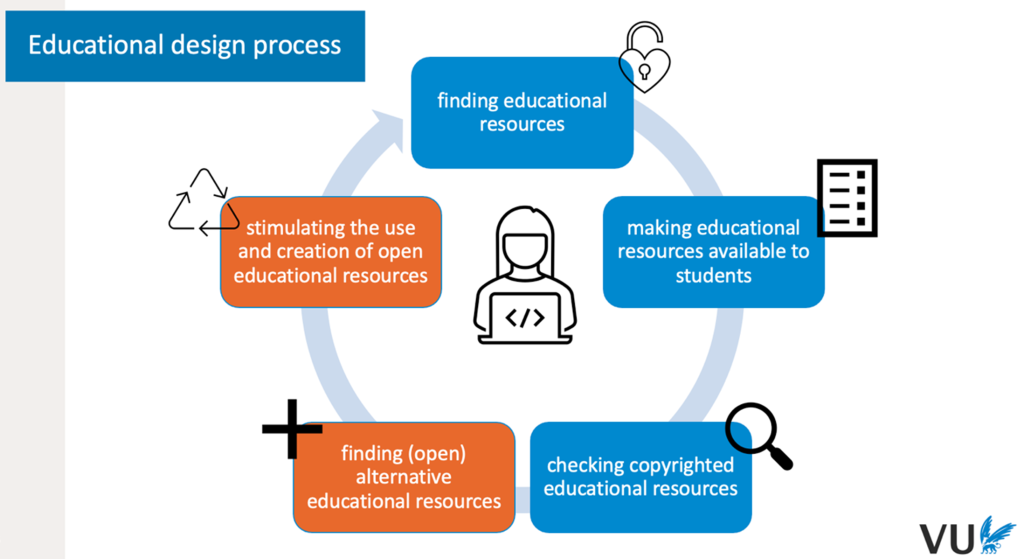
This design required supporting resources, benefitting both library and educational management. We strive for a change from a non-binding to a conscious use of learning materials.
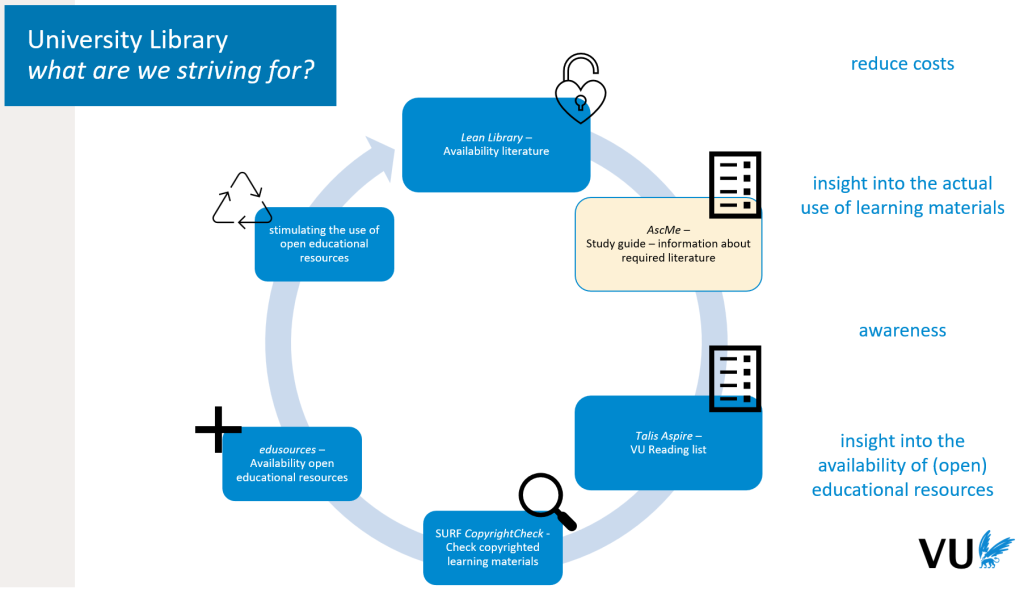
From the task of organising the provision of learning materials to students more logically, the university library wondered what (innovative) tools were available. It took the VU two years of thinking, using already existing resources, to come up with a landscape (fig. 2).
The ideal workflow consisted of a lecturer finding content and providing this content to students, whilst ensuring that there are no possible issues around copyright.
How is this achieved? As described on the graphic above (fig. 2), VU begins by ensuring their provision has the correct tools for the job and that their systems are organized logically and in a structured manner to encourage the goal of stimulating the use of open educational resources.
This landscape has impacted the way lecturers are designing their course. The recommended workflow would begin with lecturers having Lean Library already installed on their browser and when they search for content online, it guides them to content that is already available in the library through WMS/OCLC. This creates a clear overview of actual available content, forming the core content of reading lists, provided to students via the VLE.
It is essential that the educators are involved in the collective responsibility for the proper use of learning materials. To effectively make this happen, one component in fig. 2 still needs to be developed: the AscMe – component. With this, educational management enters the required literature into the study guide, from which a reading list can then also easily be created. If this part can be implemented in the existing landscape, it will fully support the conscious use of learning materials.
During teaching periods, lecturers add more literature and additional information to courses in the VLE. To ensure all content is copyright cleared, it goes through SURF CopyrightCheck and then added to the VLE. Once in the VLE, educational management receive periodic reports of the usage that those materials have, giving a clear overview of available content, opening the opportunity to discuss how and what materials lecturers and educational management are using. This even presents an opportunity to recreate certain materials and making them open available (OER). VU’s ultimate goal is to encourage the use of open educational resources and open repositories, including adding new content to the Dutch service: edusources, where higher education – institutions work together to create, share and use content to enrich education.
In discussions with the educational staff, this landscape is the starting point to encourage the awareness process regarding the appropriate use of learning materials, without infringing copyrighted materials.
When this is implemented correctly, it has obvious benefits for education:
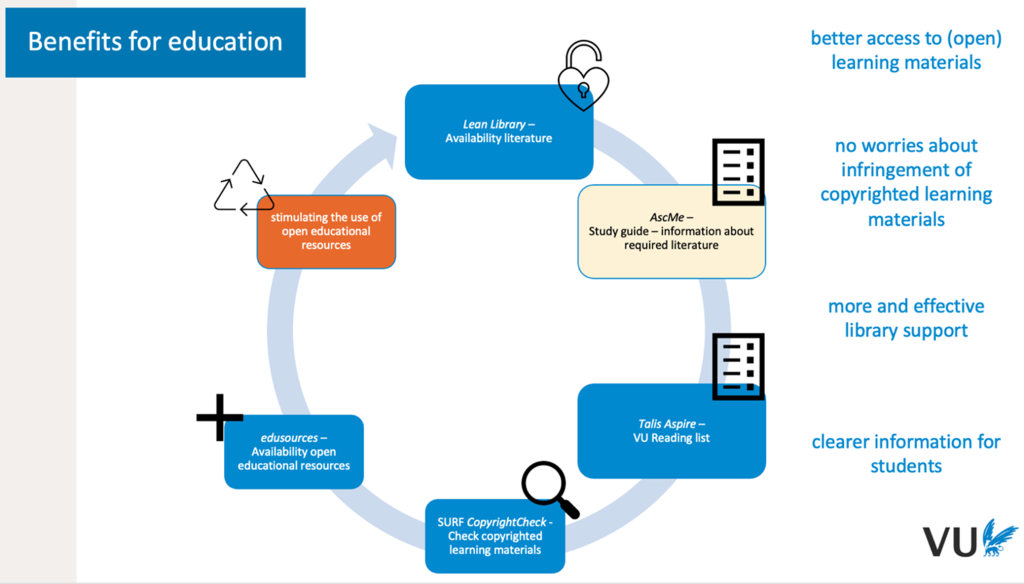
Essential in this process is supporting the conscious use of learning materials. VU has a very structured system to support the logistics of administrative and organizational support for education. The logistics of an educational program. This starts with collecting information about courses, people involved, schedules, study guides and the content within each course, indicating required reading for students and content they need to purchase in order to take the courses appropriately.
This process of gathering the necessary information makes up their educational program, VU refers to as the Academic Structure & Content Modelling Environment (AscMe). Together with the supplier (TimeEdit) the VU is working to expand opportunities of AscMe on providing literature-information. With the goal being that when a program director adds literature to AscMe, it will be -via Talis Aspire- directly integrated with VU’s LMS. This will mean that lecturers and students will always have the right information available on reading lists. With this landscape in place, VU will get greater usage insights and a nice overview of the required literature being used in education. This bridges the gap between lecturers and students when it comes to considering the right content, together with reducing copyright infringements.
From a technical perspective, everything was fairly easy to set up:
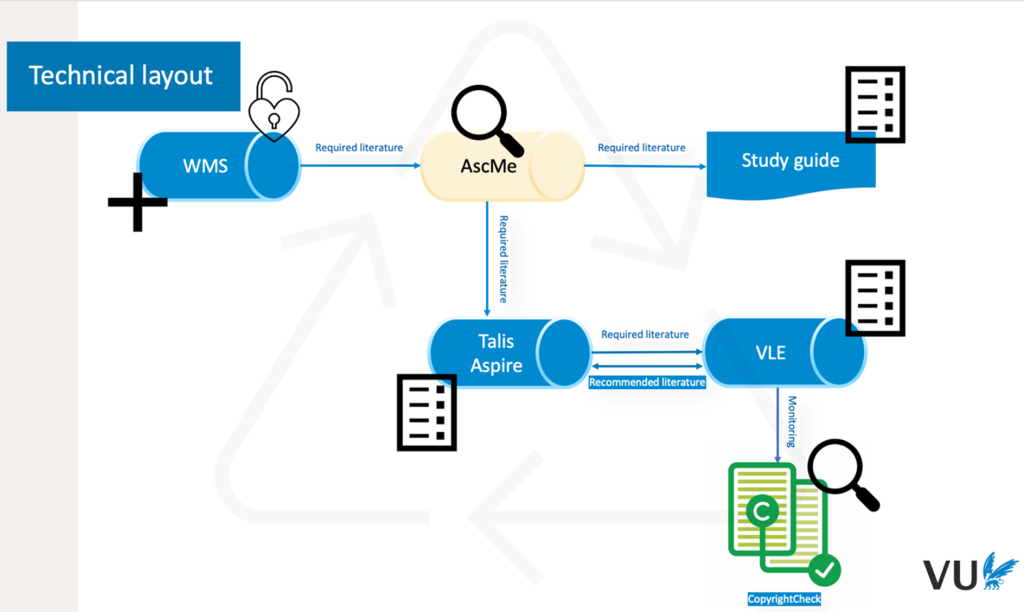
In summary, Talis Aspire provided a solution that would not only make reading lists easily available in education, but it contributed to the vision the VU has around the use of open educational resources. This included reducing copyright infringements and having learning materials easily available in the learning environment of students, in addition to a better and more efficient management of learning materials.
Adopting Talis Aspire had been a possibility for a while, but the institution was initially not ready until the creation of the educational support department of the university library. Insights were uncovered during the exploration stage, however Covid put the process on hold, with the final decision to adopt Talis Aspire made in the spring of 2022.
The use of Talis Aspire will be a gradual process, with information specialists and lecturers being informed about the implementation and inclusion during the set-up period. VU’s goal is to have Talis Aspire fully operational by the start of the 2024-2025 academic year. With the knowledge and experience that will be gathered from using Talis Aspire and CopyrightCheck, VU wants to convert non-binding into conscious use, in order to have the landscape fully integrated by 2025-2026. With the inclusion of Talis Aspire, VU want to make education ready for exciting new possibilities, matching the university’s vision of unburdening, connecting and innovating.
Collaboration with the Talis Aspire team has been a very smooth process, with a clear interest in each other’s wishes and respect for all (im)possibilities.
Cees van Gent, Head of Educational Support of the University Library, Vrije Universiteit Amsterdam
VU still are in the exploratory phase, so there is currently no hard data, however lecturers have been very enthusiastic over the possibilities offered by Talis Aspire and the library team are looking forward to gathering previously unavailable data. There has even been student feedback positively commenting on the initial VU reading lists, and the VU rector will soon share his favourite reading list to the entire academic community.
The communication strategy was not only aimed at users, but (especially) higher management was also approached and convinced. The Directors of Operations and the Vice Deans of Education of all faculties were informed in sessions about the possibilities of Talis Aspire (and SURF CopyrightCheck). The focus was on cost reduction and didactic possibilities. This has led them to advise making these resources available for education. They are now participating in the strategy to get the process accepted at VU.
VU’s goal is to have Talis Aspire fully operational in all education for the academic year 2024 – 2025. The experience gained with Talis Aspire (and CopyrightCheck) enable VU to change the optional, non-binding use into a conscious one, and thus to achieve the fully-integrated landscape in 2025 – 2026.
For the first time I have an overview what is really happening in education regarding the use of learning materials. Especially around the required literature we need to have available for students to prepare for their exams.
Cees van Gent, Head of Educational Support of the University Library, Vrije Universiteit Amsterdam
If you’d like to hear more or receive a product demo, get in touch.
Talis Aspire in 2023: Connecting Libraries with Faculty and Students December 19, 2023As we bid farewell to 2023, we took the opportunity to reflect on how the Talis Aspire resource list management system connected libraries with faculty and students this year via their course lists. Read on for a round-up of how Talis Aspire supported student reading this year, new developments to the platform, new university partners we welcomed, and what to expect from Talis Aspire in 2024.
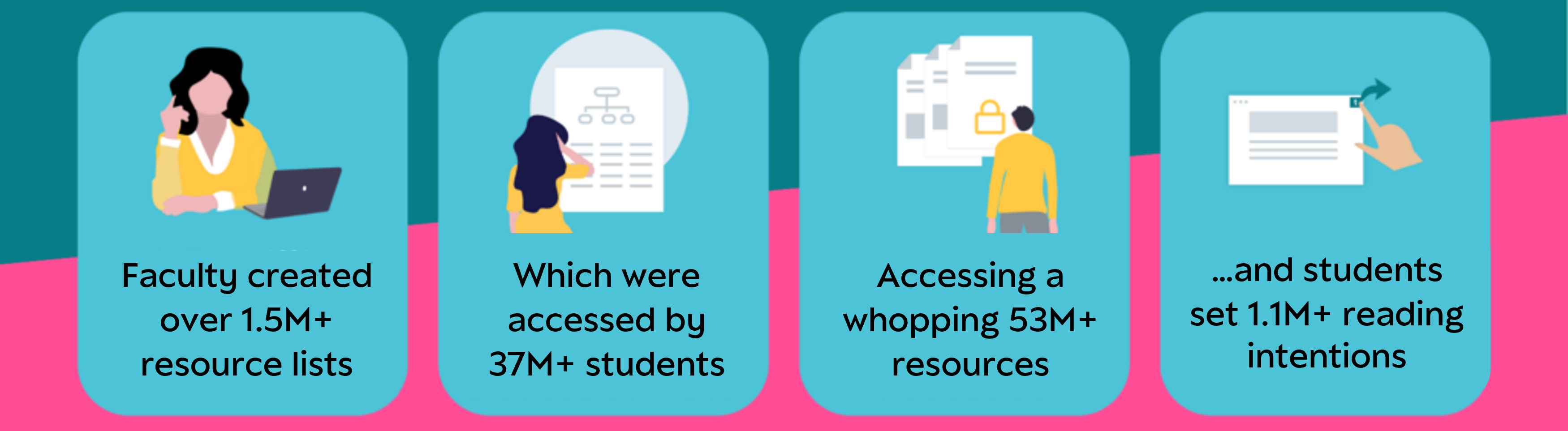
Faculty and other list creators at institutions created over 1.5 million resource lists on Talis Aspire in 2023 alone – that’s a lot of reading! These lists were accessed by over 37 million students, connecting them with over 53 million learning resources. Furthermore, students set 1.1 million reading intentions on the Talis Aspire platforms, helping hone their academic reading and study skills.
Talis Aspire continues to be a preferred resource list management for libraries not just in the UK but around the world. It works flexibly with all major library management systems (including ExLibris Alma, OCLC WMS , EBSCO FOLIO, Koha and more) to embed the library in the heart of teaching and learning. In addition to our 100 strong customer base, we welcomed new universities to the Talis Aspire community in 2023, including Loughborough University, University of North Alabama, Douglas College and University of Kentucky.
Curating a pedagogically robust course resource list makes all the difference to both student enjoyment and success. However, curating resource lists for modules, courses, extra curricular training or more takes huge amount of knowledge and expertise. The Talis Aspire community chose some of the best resource lists created on Talis Aspire this year, based on their use of structure, signposting, diversity of resources, and more. Browse the list below for just a taster of how Talis Aspire helps teachers do their best work:
Demands on the library are increasing and evolving. We recognized that Talis Aspire must too evolve to best support librarians, so we stepped up product development with a brand new product team and increased resource in 2023. Below is an overview of three exciting areas of development to the Talis Aspire platform in 2023:
Talis Aspire launched new integrations with library discovery services Primo, WorldCat and ESBCO Discovery Service (EDS), followed by Summon. These integrations enables users to search for resources via your library discovery system (i.e. your library’s existing internal holdings, licenses and subscriptions), directly within Talis Aspire. The flexibility of Talis Aspire being ILS-agnostic with its integrations means that, no matter which discovery system the library uses:
We undertook an intense customer listening exercise and grouped customer feedback from the last few years into key themes to build into the Talis Aspire product roadmap. The themes included list editing, reviews, self-service, analytics & reporting, and customization. This exercise meant we developed faster, more aligned to library needs and had some very happy customers! Watch the webinar recording below to hear Scott Gibbens, Head of Product for Talis, cover what we learned from the customer feedback exercise and what was delivered earlier in 2023.
In addition to the new integrations and feedback themed release, we also sped up and increased continuous improvement development to Talis Aspire. Below we highlight just a few of the cool, new features, enhancements and improvements to user experience:
Thank you to all our partner universities and congratulations on achieving these wonderful results on Talis Aspire. More exciting improvements and developments are planned for Talis Aspire next year, including improved reviews and acquisitions workflows and enhanced integrations to better streamline how librarians make acquisitions from Talis Aspire.
If your library does not yet use Talis Aspire but is looking to implement a new resource list management system, or wants to see how Talis Aspire compares to your library’s current resource list manager, get in touch: